VOCE

VOCE visual guides

Choose a question, open its diagram and follow the links to the full framework. PNG summaries and detailed PDF guides are available in the selected language for sharing.

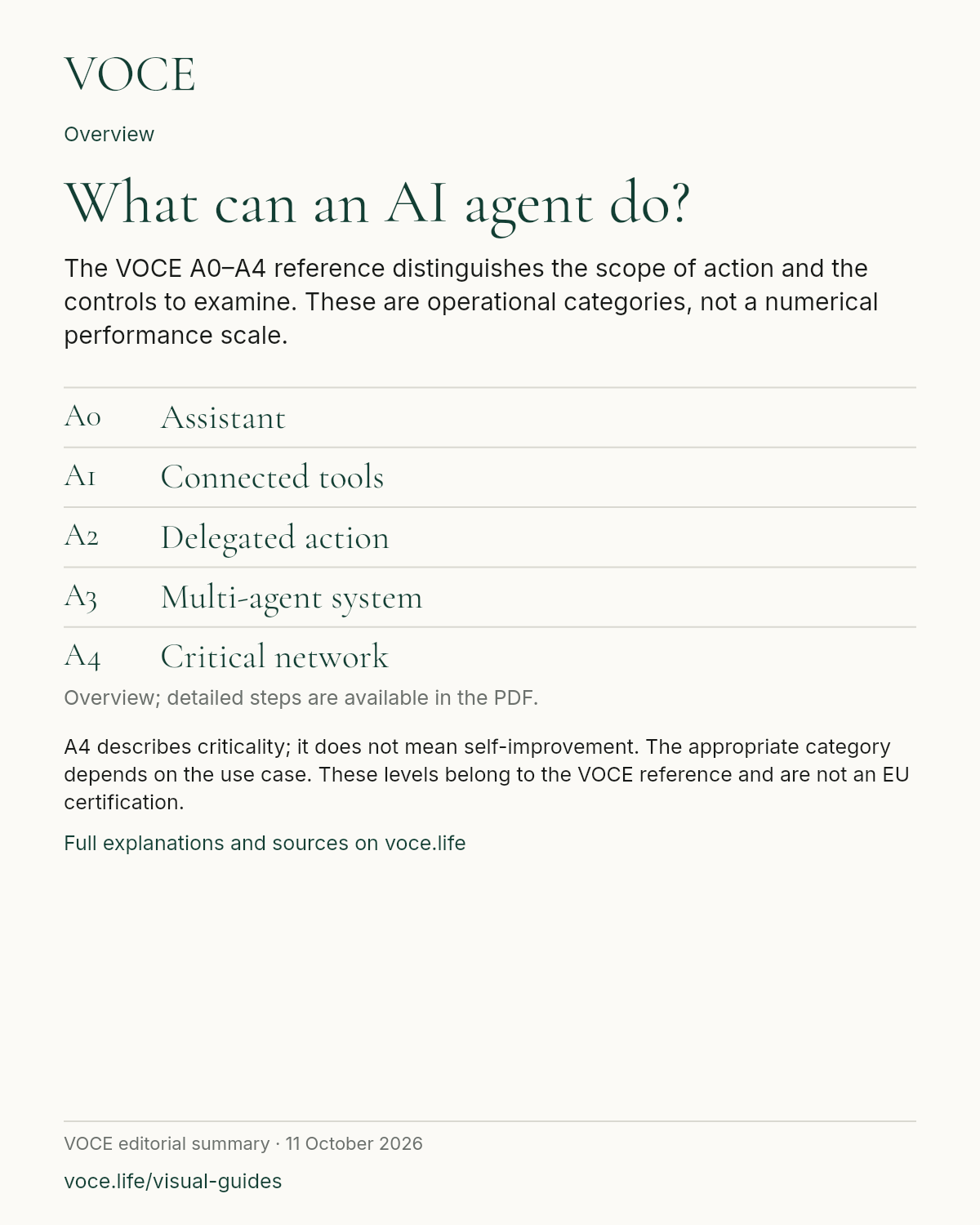
What can an AI agent do?

The VOCE A0–A4 reference distinguishes the scope of action and the controls to examine. These are operational categories, not a numerical performance scale.

Understand with a diagram
Read the text version
  1. A0 · Assistant

    Generates or retrieves information without external action.

    Human responsibility: Review the answers and their sources.

  2. A1 · Connected tools

    Uses approved tools for reading or low-impact tasks.

    Human responsibility: Limit access and ensure it can be revoked.

  3. A2 · Delegated action

    Performs business actions within a defined mandate.

    Human responsibility: Set transaction limits, approvals and recovery procedures.

  4. A3 · Multi-agent system

    Coordinates agents, models and tools across systems.

    Human responsibility: Trace the delegation chain and evaluate shared outcomes.

  5. A4 · Critical network

    Operates in contexts with potentially critical consequences.

    Human responsibility: Assign an accountable owner and test emergency intervention.

A4 describes criticality; it does not mean self-improvement. The appropriate category depends on the use case. These levels belong to the VOCE reference and are not an EU certification.

VOCE editorial summary · 11 October 2026 · The full framework remains the reference.
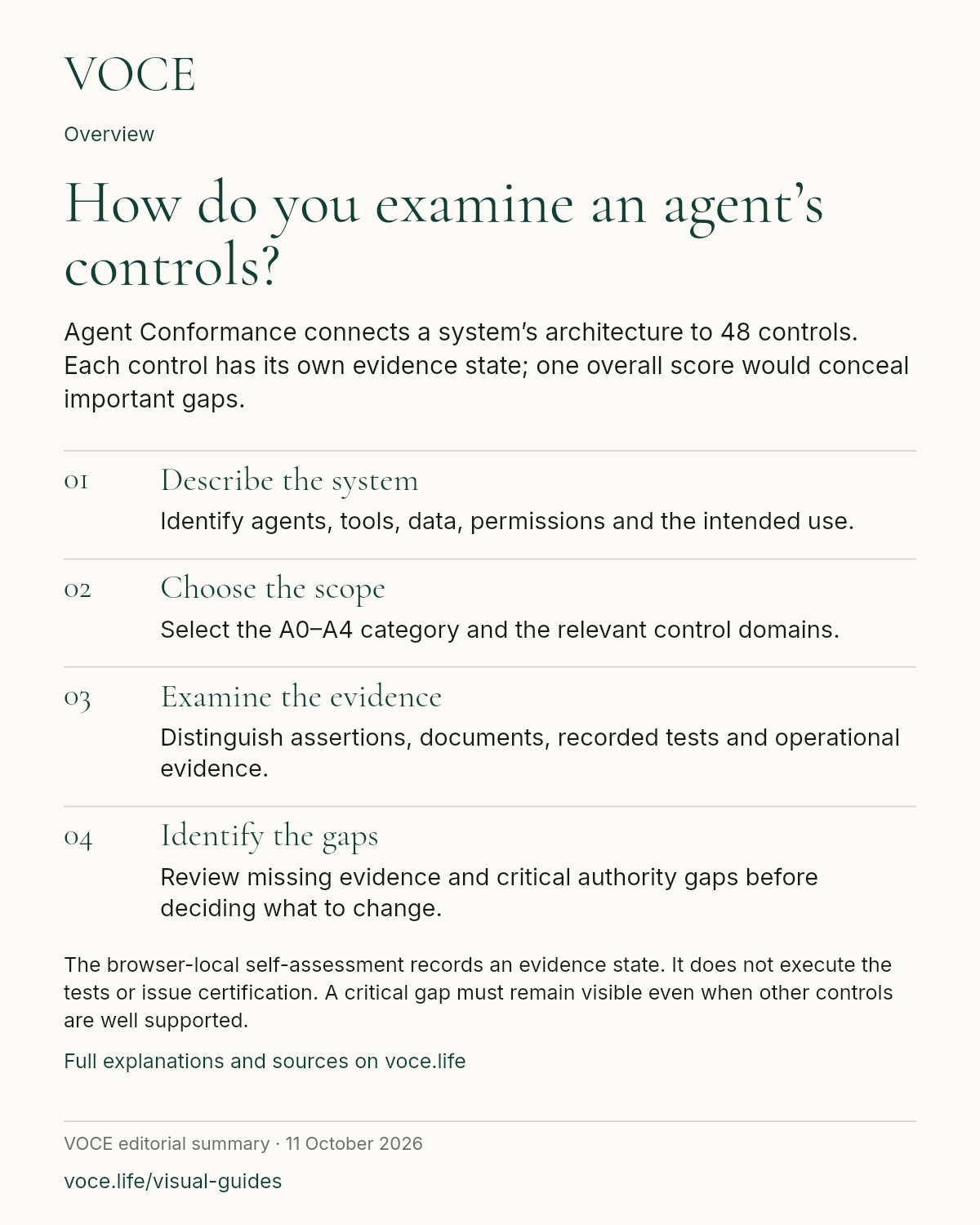
How do you examine an agent’s controls?

Agent Conformance connects a system’s architecture to 48 controls. Each control has its own evidence state; one overall score would conceal important gaps.

Understand with a diagram
Read the text version
  1. Describe the system

    Identify agents, tools, data, permissions and the intended use.

  2. Choose the scope

    Select the A0–A4 category and the relevant control domains.

  3. Examine the evidence

    Distinguish assertions, documents, recorded tests and operational evidence.

  4. Identify the gaps

    Review missing evidence and critical authority gaps before deciding what to change.

What supports a control?

  • Absent: No reliable evidence.
  • Declared: An assertion without adequate supporting evidence.
  • Documented: A current policy, configuration or architecture record.
  • Tested: A defined test with a recorded result.
  • Verified in operation: Current evidence from the deployed environment.

The browser-local self-assessment records an evidence state. It does not execute the tests or issue certification. A critical gap must remain visible even when other controls are well supported.

VOCE editorial summary · 11 October 2026 · The full framework remains the reference.
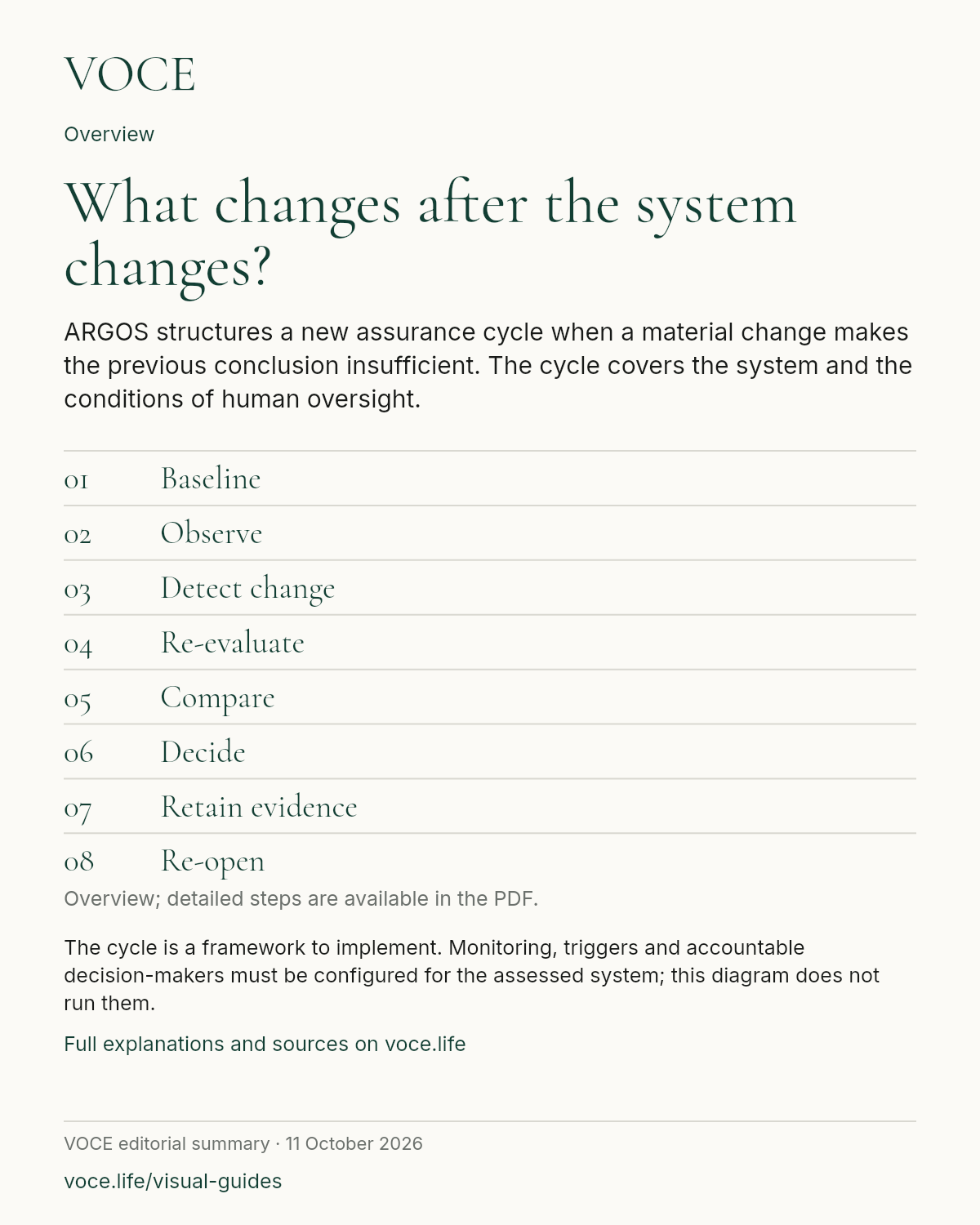
What changes after the system changes?

ARGOS structures a new assurance cycle when a material change makes the previous conclusion insufficient. The cycle covers the system and the conditions of human oversight.

Understand with a diagram
Read the text version
  1. Baseline

    Record the versions, permissions and configuration being assessed.

  2. Observe

    Examine actual tasks, errors, costs and human interventions.

  3. Detect change

    Identify a material change, drift, incident or supplier event.

  4. Re-evaluate

    Repeat the relevant task, security, authority and cognitive-control evaluations.

  5. Compare

    Compare the new results with the accepted baseline.

  6. Decide

    Continue within conditions, restrict, roll back or withdraw the capability.

  7. Retain evidence

    Keep the dated results, decision and accountable owner.

  8. Re-open

    Start another cycle at the next material change.

The cycle is a framework to implement. Monitoring, triggers and accountable decision-makers must be configured for the assessed system; this diagram does not run them.

VOCE editorial summary · 11 October 2026 · The full framework remains the reference.
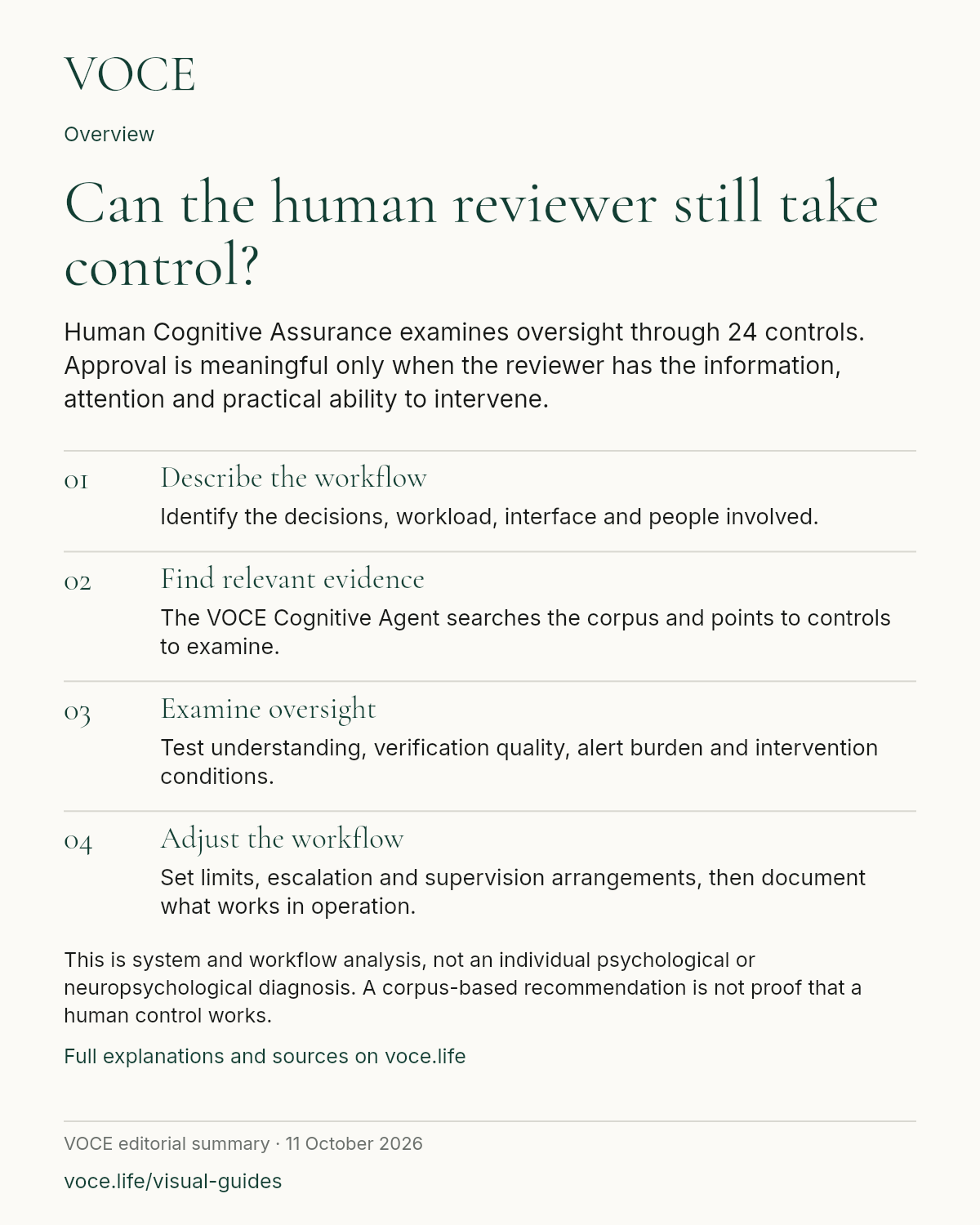
Can the human reviewer still take control?

Human Cognitive Assurance examines oversight through 24 controls. Approval is meaningful only when the reviewer has the information, attention and practical ability to intervene.

Understand with a diagram
Read the text version
  1. Describe the workflow

    Identify the decisions, workload, interface and people involved.

  2. Find relevant evidence

    The VOCE Cognitive Agent searches the corpus and points to controls to examine.

  3. Examine oversight

    Test understanding, verification quality, alert burden and intervention conditions.

  4. Adjust the workflow

    Set limits, escalation and supervision arrangements, then document what works in operation.

This is system and workflow analysis, not an individual psychological or neuropsychological diagnosis. A corpus-based recommendation is not proof that a human control works.

VOCE editorial summary · 11 October 2026 · The full framework remains the reference.
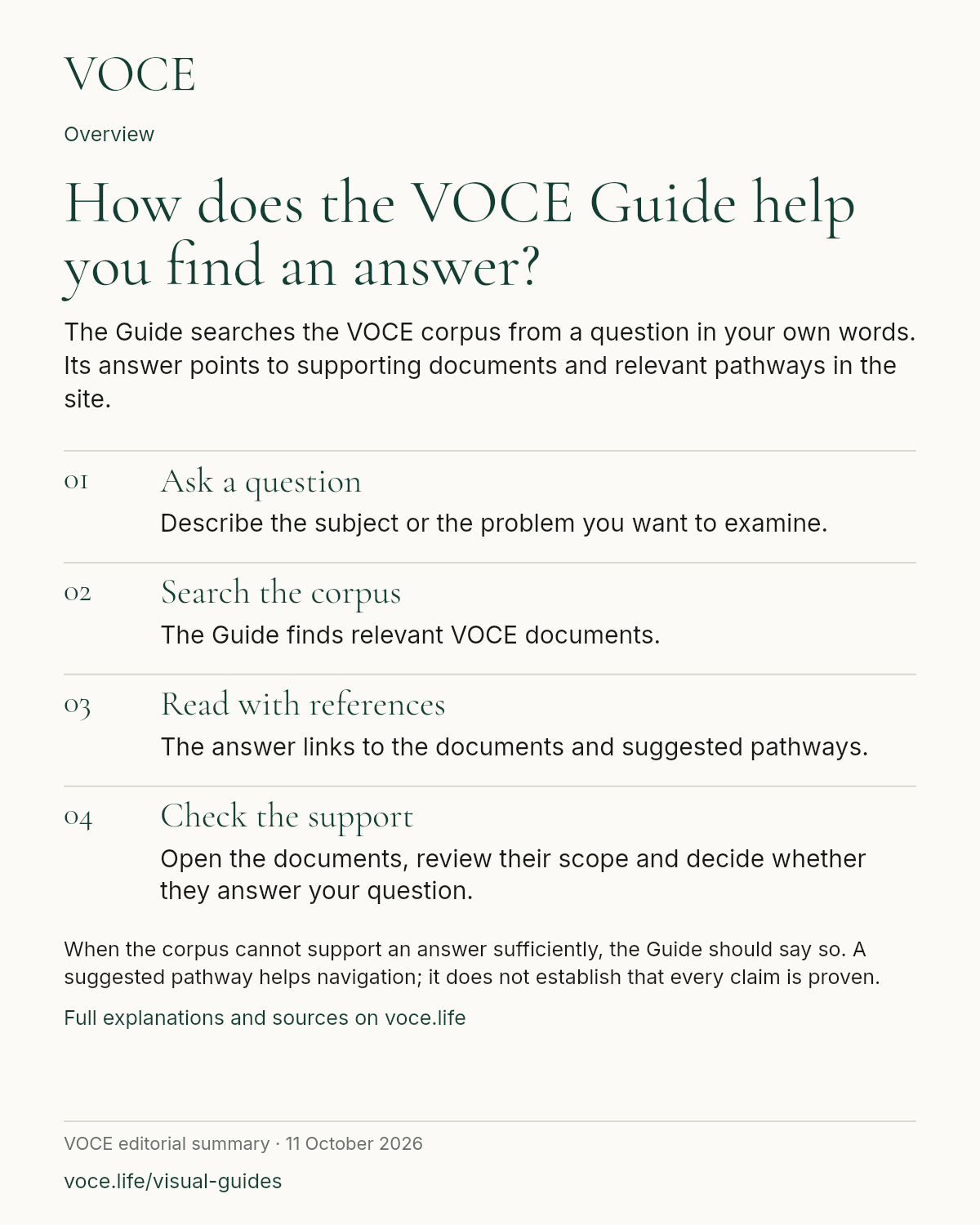
How does the VOCE Guide help you find an answer?

The Guide searches the VOCE corpus from a question in your own words. Its answer points to supporting documents and relevant pathways in the site.

Understand with a diagram
Read the text version
  1. Ask a question

    Describe the subject or the problem you want to examine.

  2. Search the corpus

    The Guide finds relevant VOCE documents.

  3. Read with references

    The answer links to the documents and suggested pathways.

  4. Check the support

    Open the documents, review their scope and decide whether they answer your question.

When the corpus cannot support an answer sufficiently, the Guide should say so. A suggested pathway helps navigation; it does not establish that every claim is proven.

VOCE editorial summary · 11 October 2026 · The full framework remains the reference.
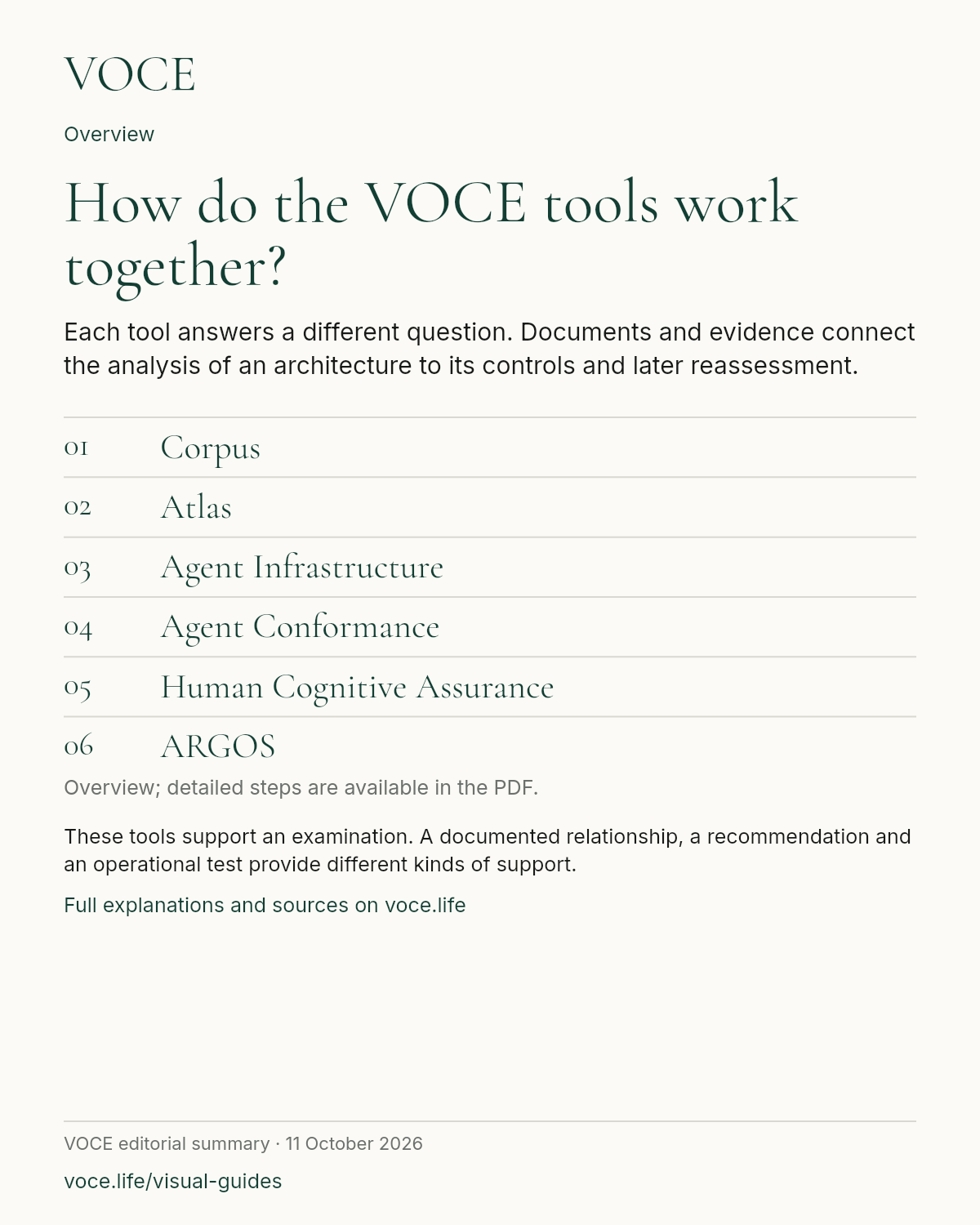
How do the VOCE tools work together?

Each tool answers a different question. Documents and evidence connect the analysis of an architecture to its controls and later reassessment.

Understand with a diagram
Read the text version
  1. Corpus

    Find the publications and sources relevant to the question.

  2. Atlas

    Explore documented relationships and return to the supporting texts.

  3. Agent Infrastructure

    Describe the system, its dependencies and its scope of action.

  4. Agent Conformance

    Examine the applicable controls and their evidence states.

  5. Human Cognitive Assurance

    Examine whether people can understand, verify and intervene.

  6. ARGOS

    Reopen the assessment after a material change and record the decision.

These tools support an examination. A documented relationship, a recommendation and an operational test provide different kinds of support.

VOCE editorial summary · 11 October 2026 · The full framework remains the reference.
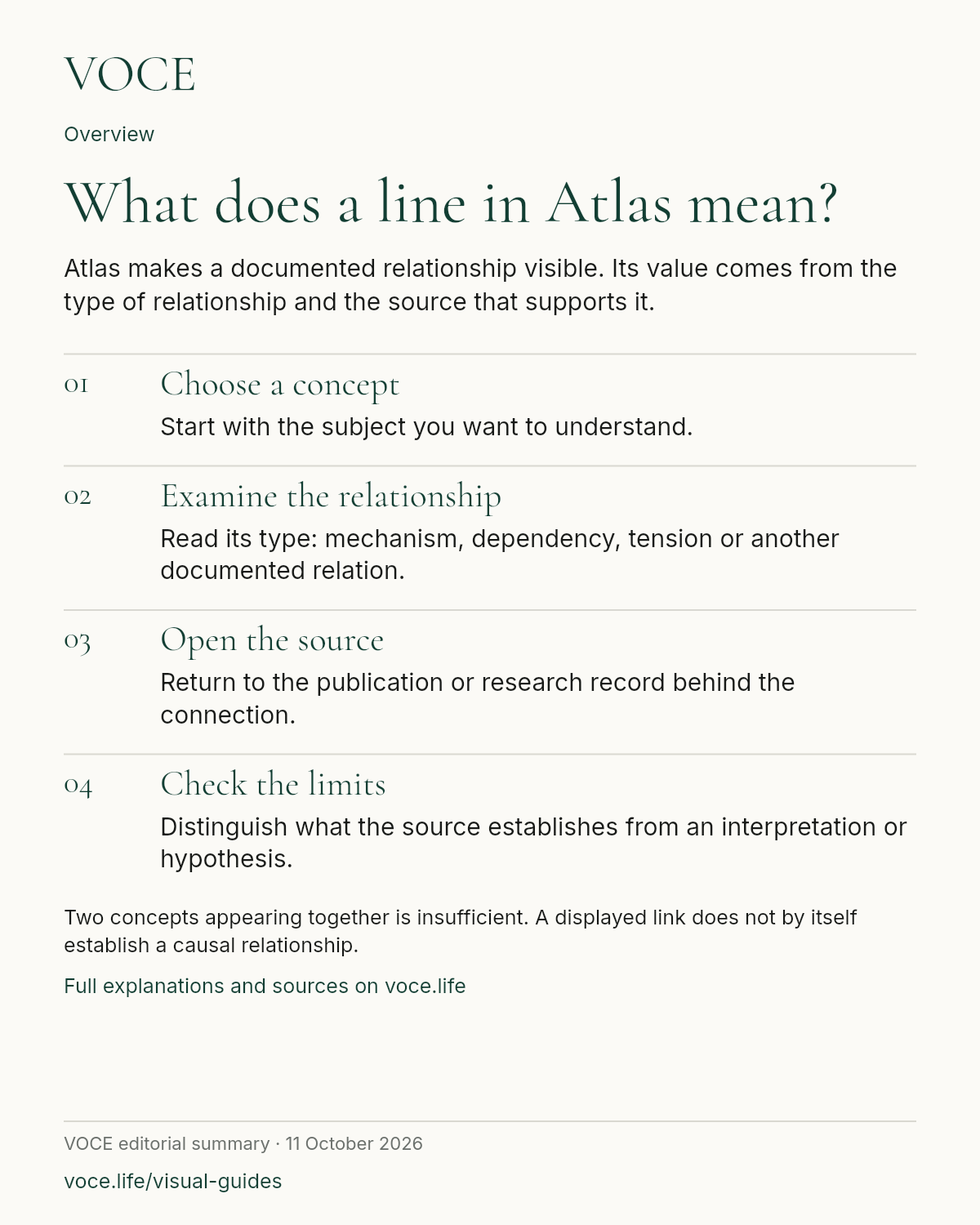
What does a line in Atlas mean?

Atlas makes a documented relationship visible. Its value comes from the type of relationship and the source that supports it.

Understand with a diagram
Read the text version
  1. Choose a concept

    Start with the subject you want to understand.

  2. Examine the relationship

    Read its type: mechanism, dependency, tension or another documented relation.

  3. Open the source

    Return to the publication or research record behind the connection.

  4. Check the limits

    Distinguish what the source establishes from an interpretation or hypothesis.

Two concepts appearing together is insufficient. A displayed link does not by itself establish a causal relationship.

VOCE editorial summary · 11 October 2026 · The full framework remains the reference.
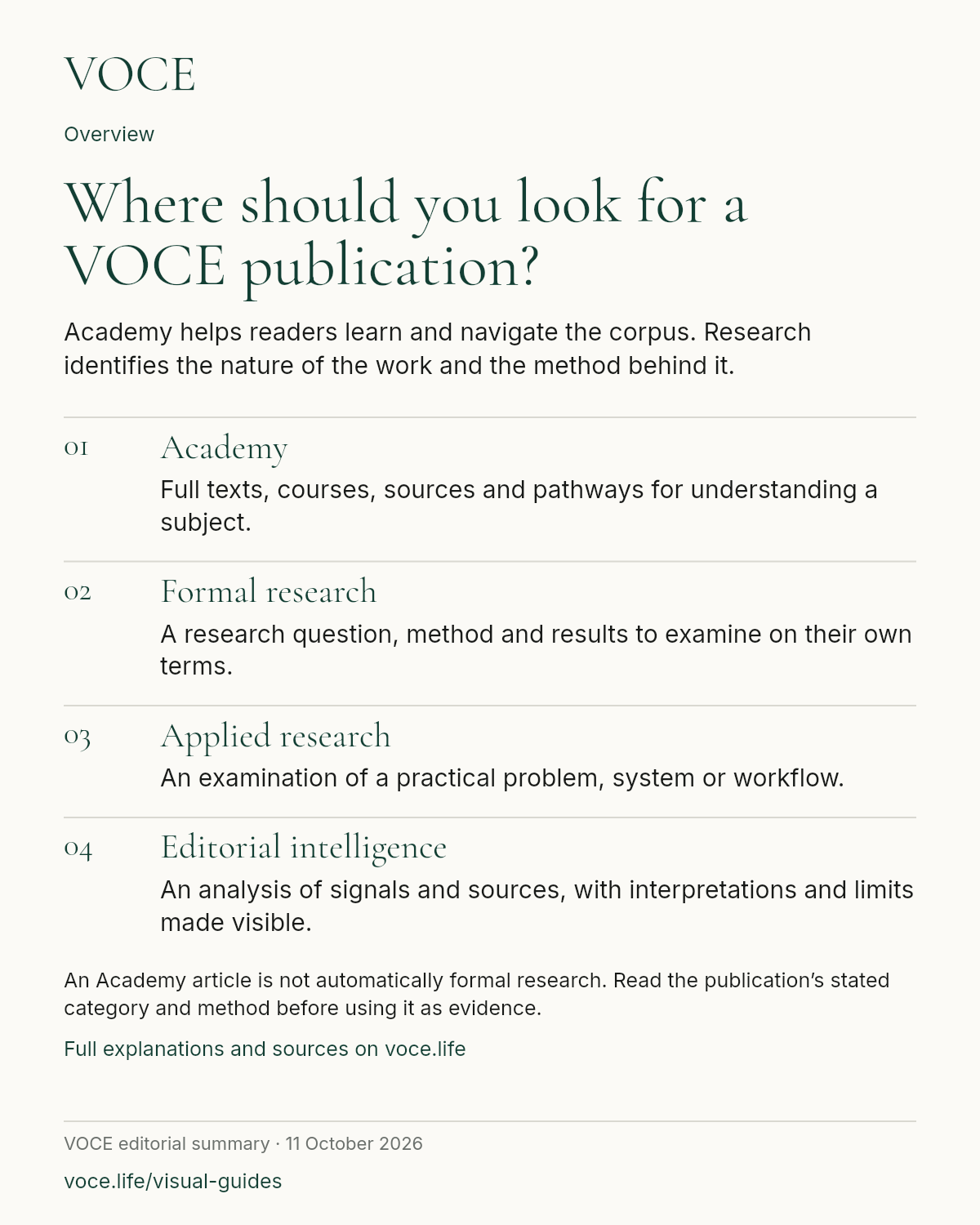
Where should you look for a VOCE publication?

Academy helps readers learn and navigate the corpus. Research identifies the nature of the work and the method behind it.

Understand with a diagram
Read the text version
  1. Academy

    Full texts, courses, sources and pathways for understanding a subject.

  2. Formal research

    A research question, method and results to examine on their own terms.

  3. Applied research

    An examination of a practical problem, system or workflow.

  4. Editorial intelligence

    An analysis of signals and sources, with interpretations and limits made visible.

An Academy article is not automatically formal research. Read the publication’s stated category and method before using it as evidence.

VOCE editorial summary · 11 October 2026 · The full framework remains the reference.
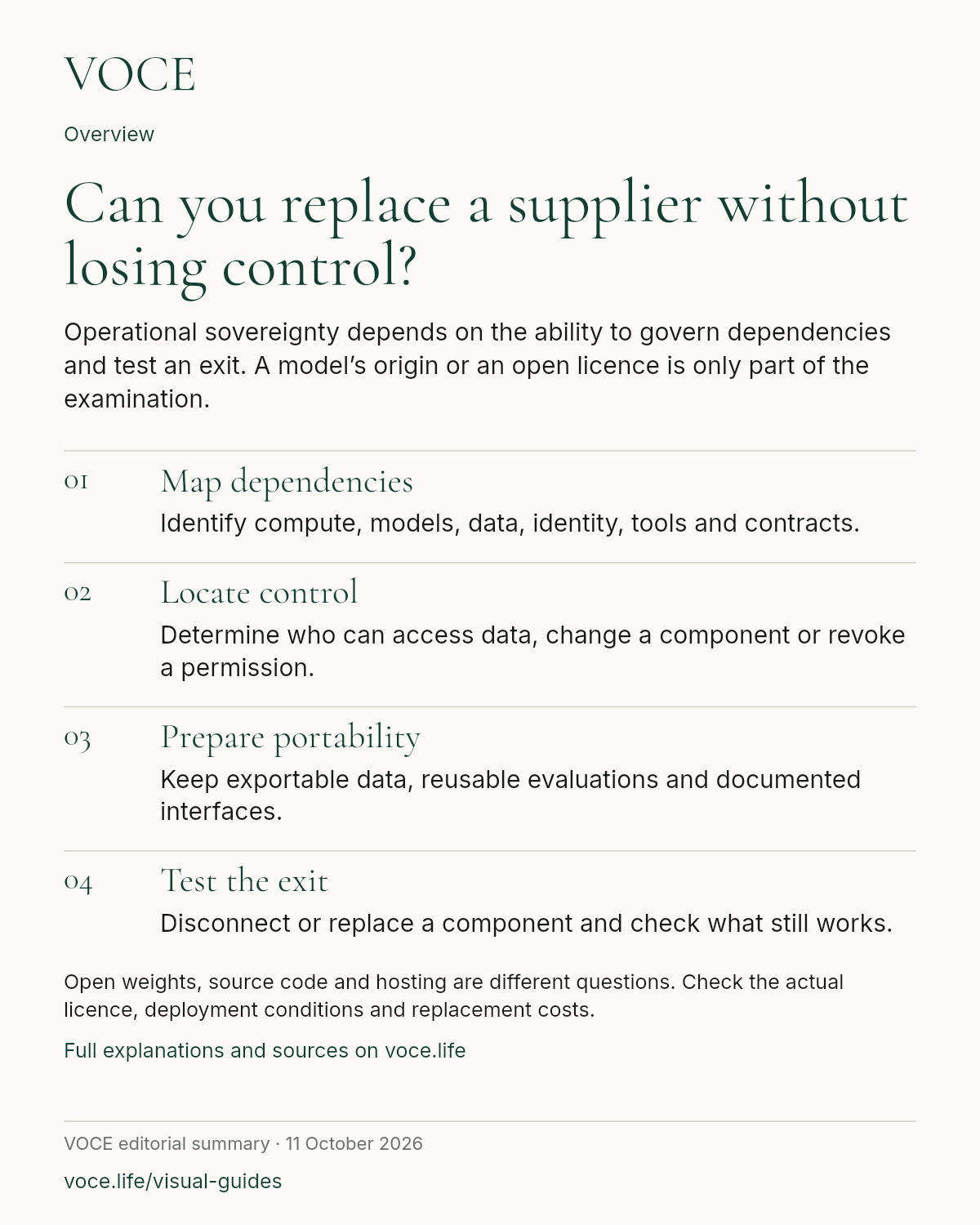
Can you replace a supplier without losing control?

Operational sovereignty depends on the ability to govern dependencies and test an exit. A model’s origin or an open licence is only part of the examination.

Understand with a diagram
Read the text version
  1. Map dependencies

    Identify compute, models, data, identity, tools and contracts.

  2. Locate control

    Determine who can access data, change a component or revoke a permission.

  3. Prepare portability

    Keep exportable data, reusable evaluations and documented interfaces.

  4. Test the exit

    Disconnect or replace a component and check what still works.

Open weights, source code and hosting are different questions. Check the actual licence, deployment conditions and replacement costs.

VOCE editorial summary · 11 October 2026 · The full framework remains the reference.
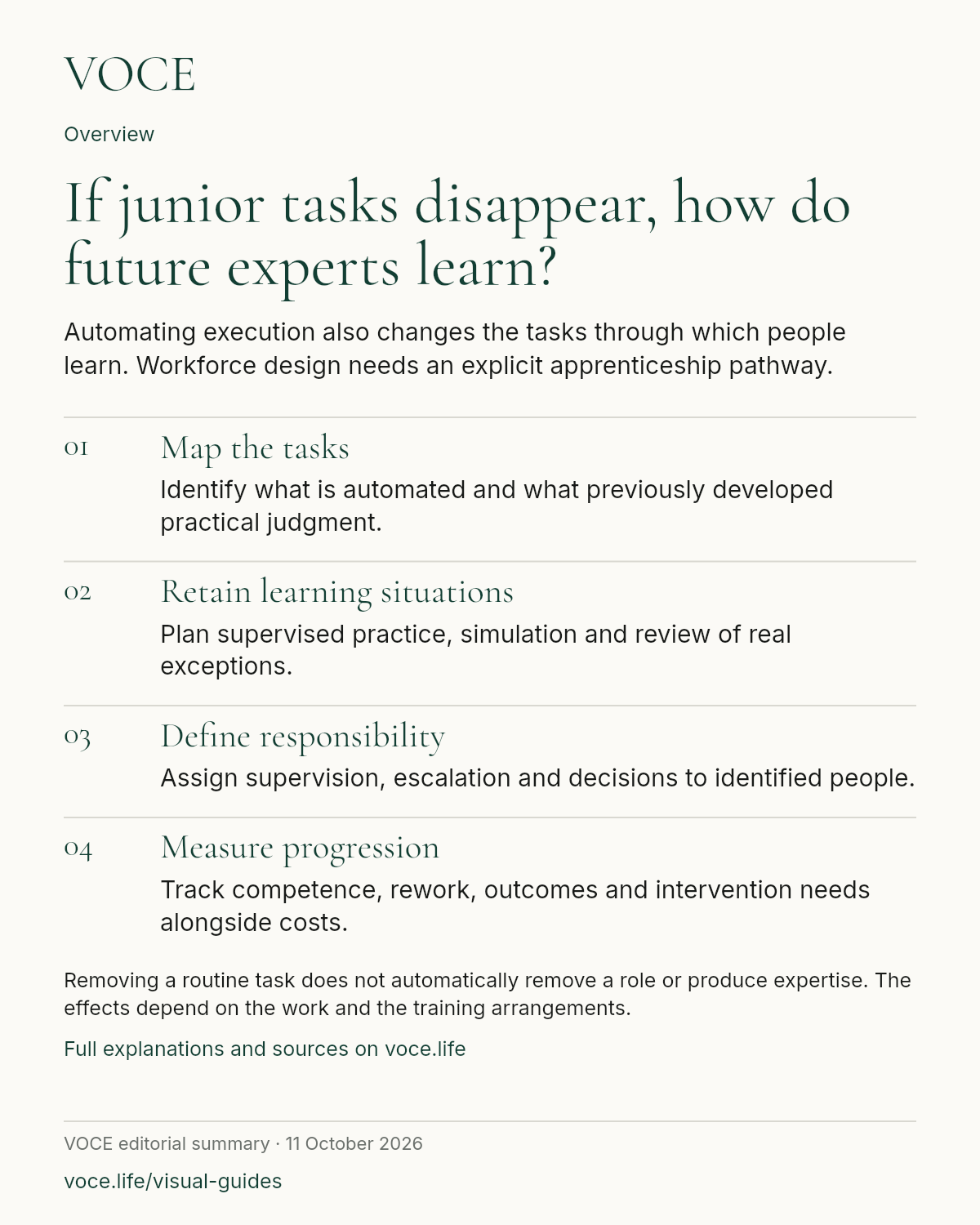
If junior tasks disappear, how do future experts learn?

Automating execution also changes the tasks through which people learn. Workforce design needs an explicit apprenticeship pathway.

Understand with a diagram
Read the text version
  1. Map the tasks

    Identify what is automated and what previously developed practical judgment.

  2. Retain learning situations

    Plan supervised practice, simulation and review of real exceptions.

  3. Define responsibility

    Assign supervision, escalation and decisions to identified people.

  4. Measure progression

    Track competence, rework, outcomes and intervention needs alongside costs.

Removing a routine task does not automatically remove a role or produce expertise. The effects depend on the work and the training arrangements.

VOCE editorial summary · 11 October 2026 · The full framework remains the reference.
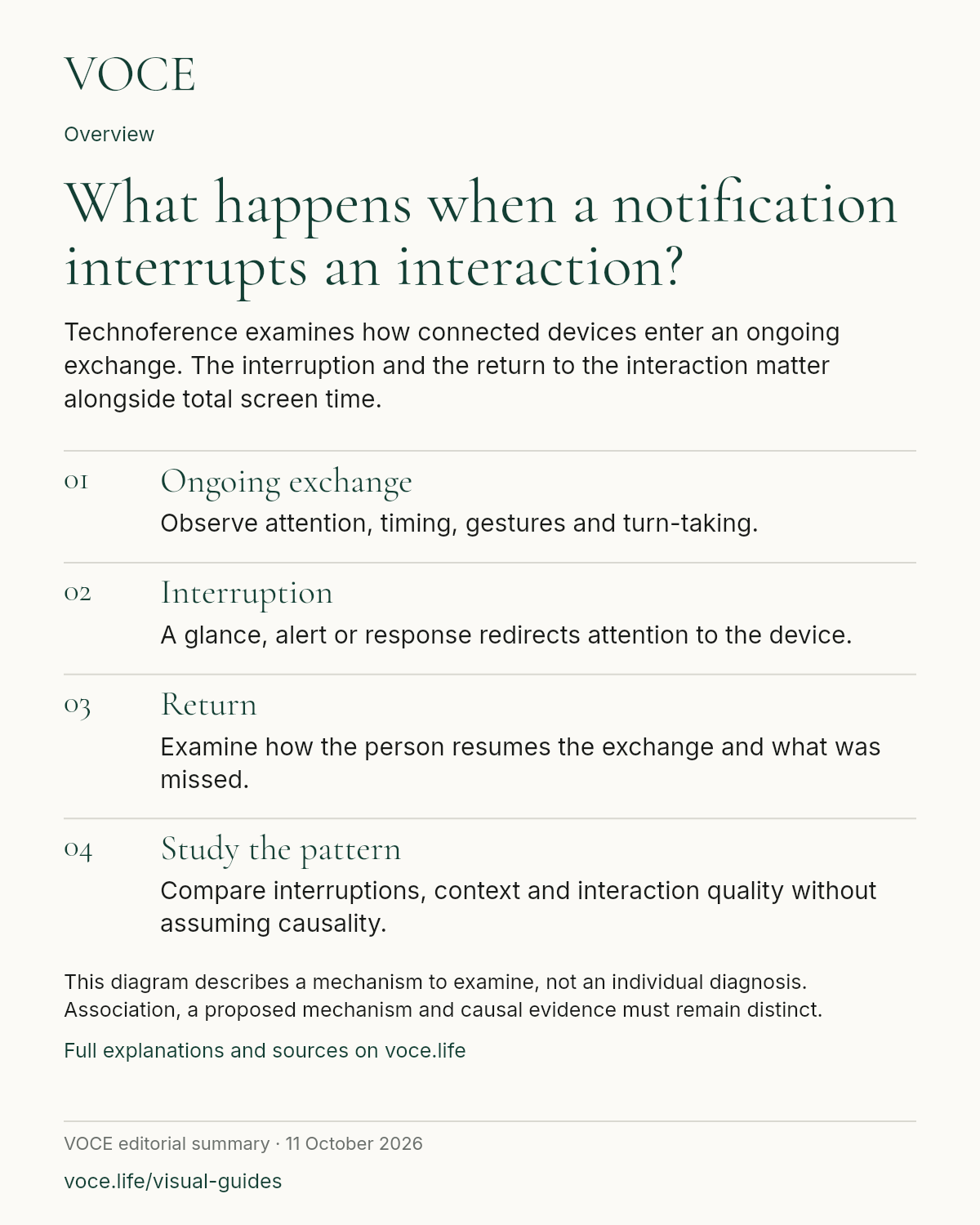
What happens when a notification interrupts an interaction?

Technoference examines how connected devices enter an ongoing exchange. The interruption and the return to the interaction matter alongside total screen time.

Understand with a diagram
Read the text version
  1. Ongoing exchange

    Observe attention, timing, gestures and turn-taking.

  2. Interruption

    A glance, alert or response redirects attention to the device.

  3. Return

    Examine how the person resumes the exchange and what was missed.

  4. Study the pattern

    Compare interruptions, context and interaction quality without assuming causality.

This diagram describes a mechanism to examine, not an individual diagnosis. Association, a proposed mechanism and causal evidence must remain distinct.

VOCE editorial summary · 11 October 2026 · The full framework remains the reference.
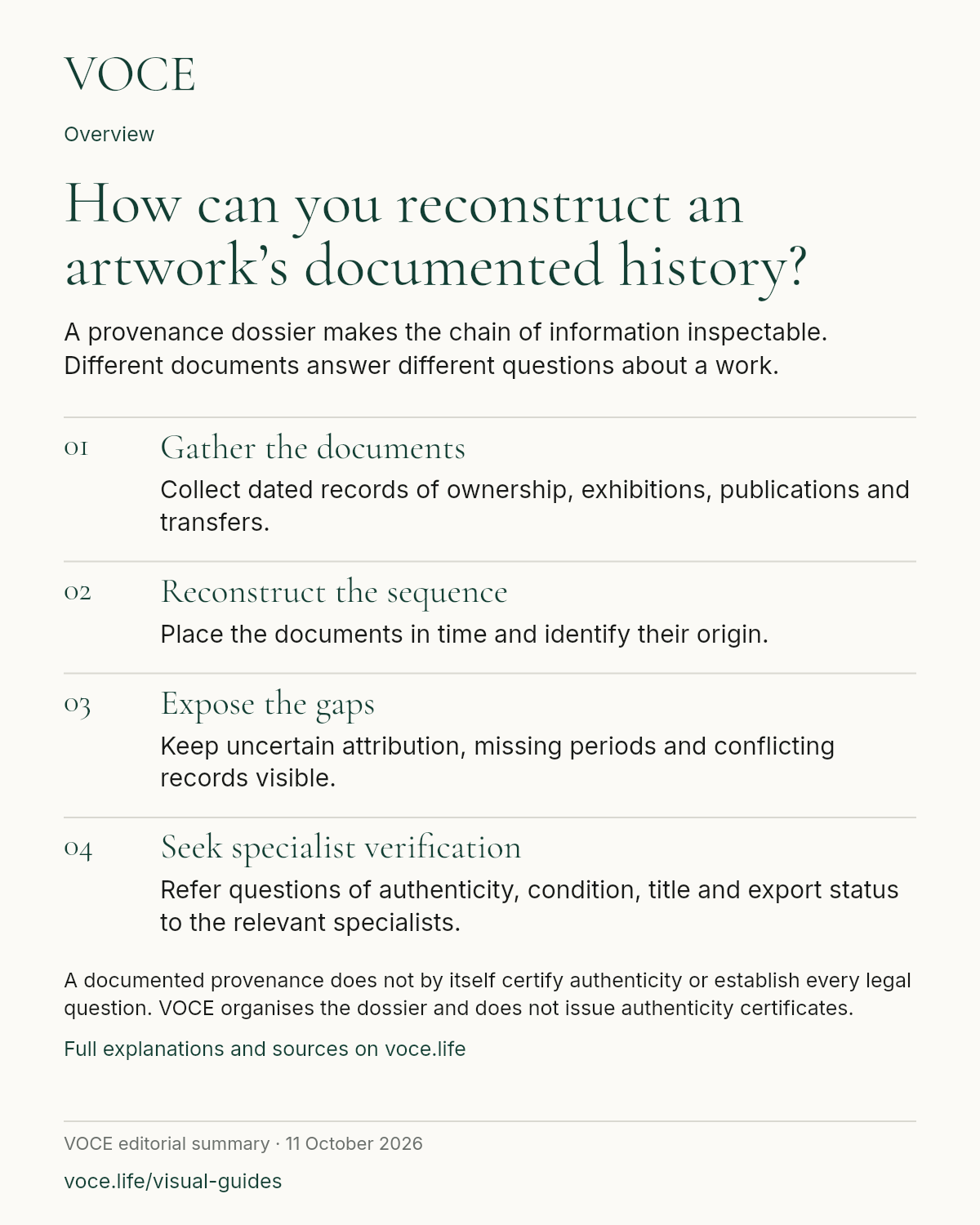
How can you reconstruct an artwork’s documented history?

A provenance dossier makes the chain of information inspectable. Different documents answer different questions about a work.

Understand with a diagram
Read the text version
  1. Gather the documents

    Collect dated records of ownership, exhibitions, publications and transfers.

  2. Reconstruct the sequence

    Place the documents in time and identify their origin.

  3. Expose the gaps

    Keep uncertain attribution, missing periods and conflicting records visible.

  4. Seek specialist verification

    Refer questions of authenticity, condition, title and export status to the relevant specialists.

A documented provenance does not by itself certify authenticity or establish every legal question. VOCE organises the dossier and does not issue authenticity certificates.

VOCE editorial summary · 11 October 2026 · The full framework remains the reference.
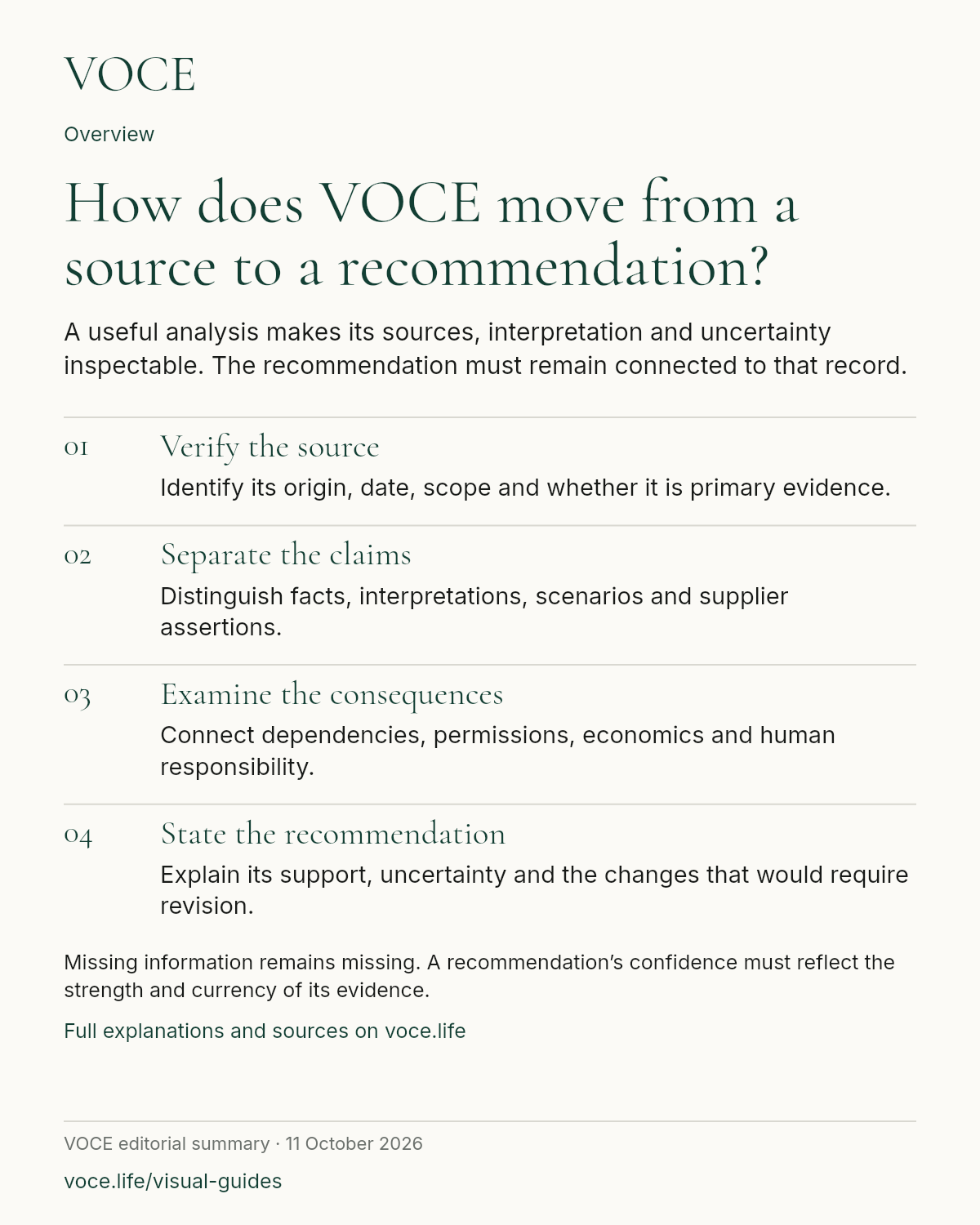
How does VOCE move from a source to a recommendation?

A useful analysis makes its sources, interpretation and uncertainty inspectable. The recommendation must remain connected to that record.

Understand with a diagram
Read the text version
  1. Verify the source

    Identify its origin, date, scope and whether it is primary evidence.

  2. Separate the claims

    Distinguish facts, interpretations, scenarios and supplier assertions.

  3. Examine the consequences

    Connect dependencies, permissions, economics and human responsibility.

  4. State the recommendation

    Explain its support, uncertainty and the changes that would require revision.

Missing information remains missing. A recommendation’s confidence must reflect the strength and currency of its evidence.

VOCE editorial summary · 11 October 2026 · The full framework remains the reference.
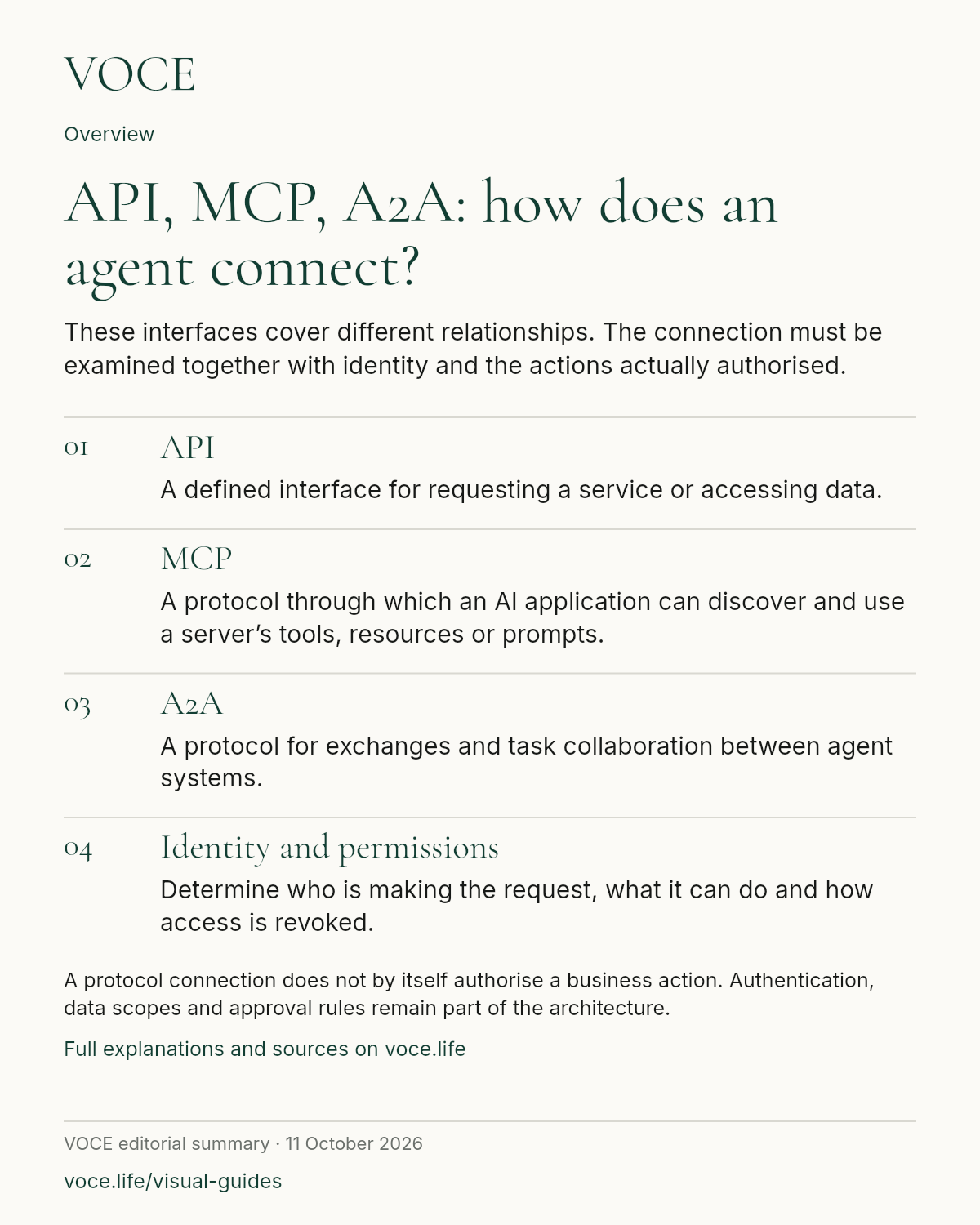
API, MCP, A2A: how does an agent connect?

These interfaces cover different relationships. The connection must be examined together with identity and the actions actually authorised.

Understand with a diagram
Read the text version
  1. API

    A defined interface for requesting a service or accessing data.

  2. MCP

    A protocol through which an AI application can discover and use a server’s tools, resources or prompts.

  3. A2A

    A protocol for exchanges and task collaboration between agent systems.

  4. Identity and permissions

    Determine who is making the request, what it can do and how access is revoked.

A protocol connection does not by itself authorise a business action. Authentication, data scopes and approval rules remain part of the architecture.

VOCE editorial summary · 11 October 2026 · The full framework remains the reference.
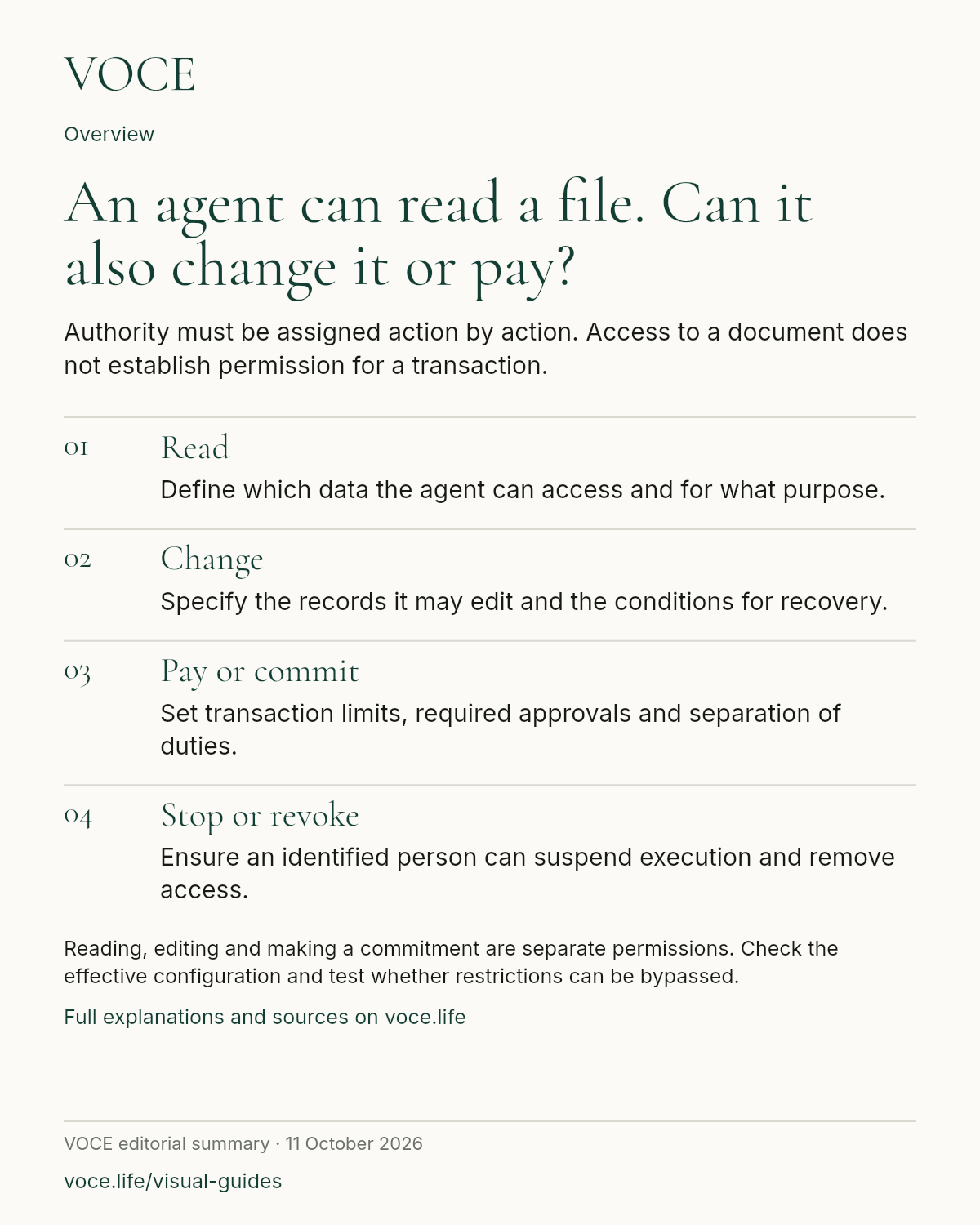
An agent can read a file. Can it also change it or pay?

Authority must be assigned action by action. Access to a document does not establish permission for a transaction.

Understand with a diagram
Read the text version
  1. Read

    Define which data the agent can access and for what purpose.

  2. Change

    Specify the records it may edit and the conditions for recovery.

  3. Pay or commit

    Set transaction limits, required approvals and separation of duties.

  4. Stop or revoke

    Ensure an identified person can suspend execution and remove access.

Reading, editing and making a commitment are separate permissions. Check the effective configuration and test whether restrictions can be bypassed.

VOCE editorial summary · 11 October 2026 · The full framework remains the reference.
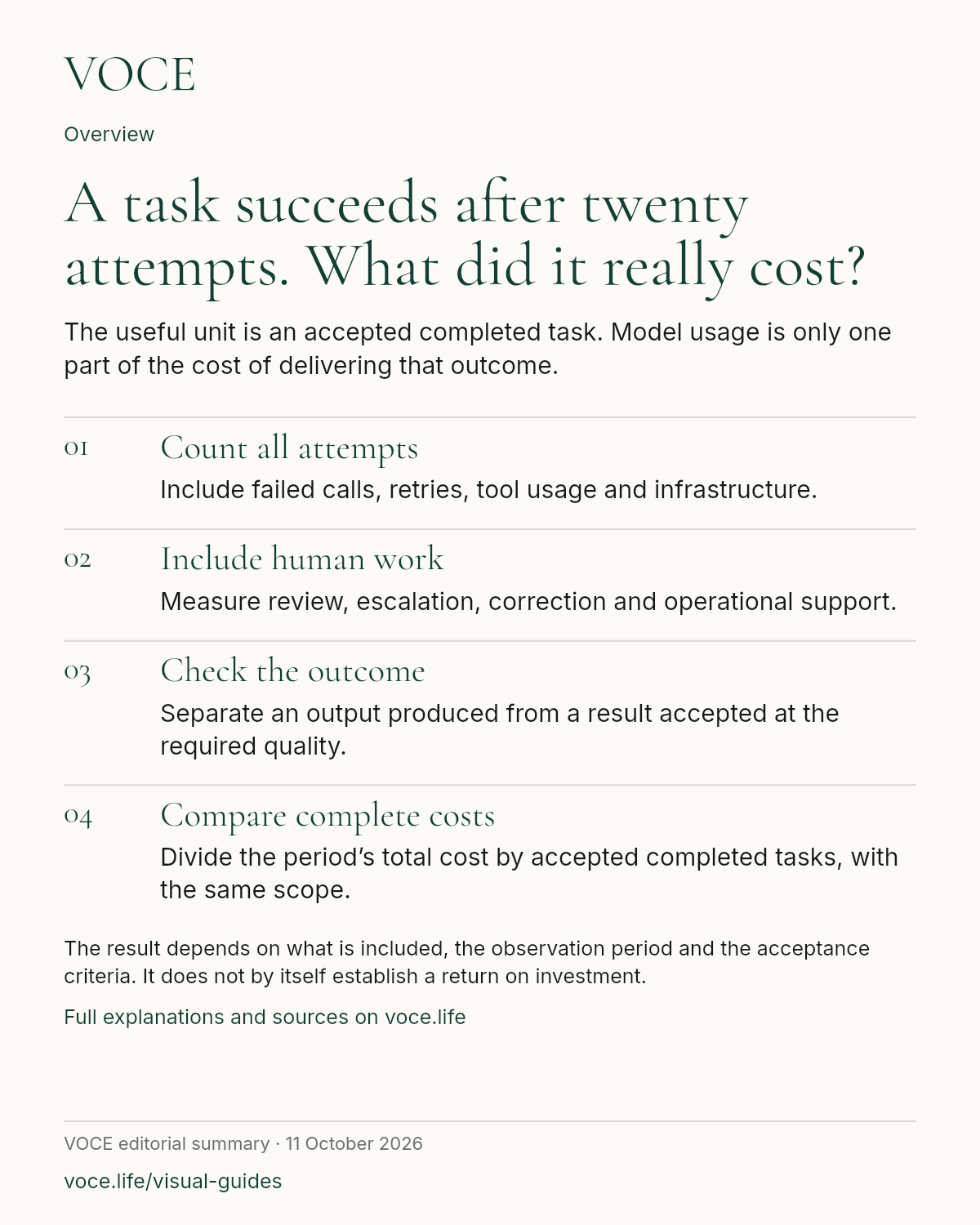
A task succeeds after twenty attempts. What did it really cost?

The useful unit is an accepted completed task. Model usage is only one part of the cost of delivering that outcome.

Understand with a diagram
Read the text version
  1. Count all attempts

    Include failed calls, retries, tool usage and infrastructure.

  2. Include human work

    Measure review, escalation, correction and operational support.

  3. Check the outcome

    Separate an output produced from a result accepted at the required quality.

  4. Compare complete costs

    Divide the period’s total cost by accepted completed tasks, with the same scope.

The result depends on what is included, the observation period and the acceptance criteria. It does not by itself establish a return on investment.

VOCE editorial summary · 11 October 2026 · The full framework remains the reference.